
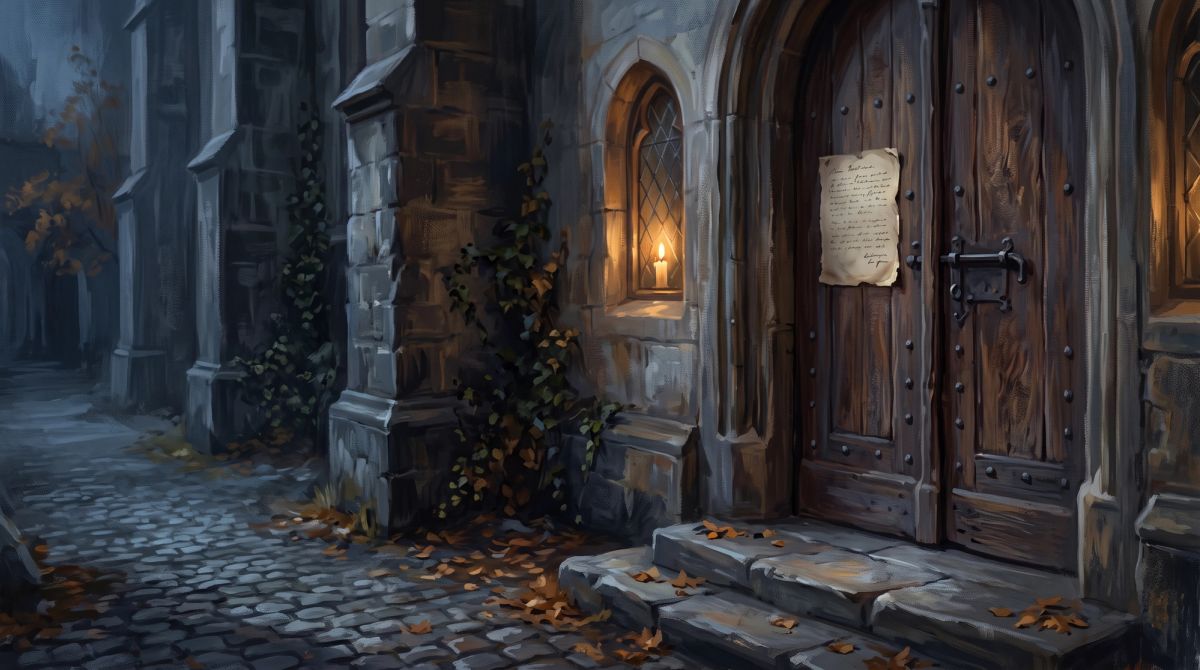
The night was cold and the harvest was in. In the villages of ancient Ireland, the fires were lit.
This was Samhain, the festival that marked the end of the Celtic harvest and the start of winter. Our best written evidence for it comes from medieval Irish texts, so much of what circulates today sounds more certain than the sources allow. The outline is clear enough, though. The turn of the season carried weight, and later tradition says the line between the living and the dead grew thin that night. People answered with bonfires and costumes and food set out for wandering spirits.
Then Christianity arrived, and the church did what it so often did with customs already rooted in the soil. It gave them a new place to stand. The church had honored its saints and martyrs for centuries, and by the eighth and ninth centuries November 1st was All Saints’ Day across much of Western Europe. Historians still argue over how much Samhain shaped that choice of date, and some think the link has been overstated. The name is on firmer ground. The evening before the feast was All Hallows’ Eve, the night before the day of the holy ones, and say that quickly enough and you get Halloween.
By the 1500s, October 31st was a fixed point on the calendar across Europe, the eve of a major feast when crowds would be gathering at the church. In 1517, a German monk chose that night to start an argument.
To understand why, we have to start with the man.
Martin Luther was not at peace with himself. He entered the monastery at Erfurt in 1505 after a violent thunderstorm, where he cried out a vow that if he lived, he would become a monk. He lived, and he kept the vow. But the monastery did not give him the assurance he came for. He wanted to know that the God he had been taught to fear had actually forgiven him.
The theology he inherited ran on penance and merit. You confessed to a priest, received absolution, completed what was prescribed, and the ledger was supposed to balance. Luther could not leave a ledger alone. He confessed so often, and over such small things, that the story goes his superior, Johann von Staupitz, told him to come back when he had done something worth confessing. The system was working exactly as designed. It simply was not working for him.
Then he was sent to Wittenberg to teach, and while preparing lectures on the Psalms and later on Paul’s letter to the Romans, something shifted. Romans 1:17 stopped him. The righteous shall live by faith. For years he had read the phrase “the righteousness of God” as a threat, a standard he could never meet. Reading it slowly in Greek and in context, he began to see that in Paul’s letter this righteousness is something God gives to the one who trusts him, as well as something God requires.
Romans 5:1 sealed it for him. Therefore, since we have been justified by faith, we have peace with God through our Lord Jesus Christ. A balanced ledger and well-managed guilt had been the best he could hope for, and Paul was describing peace.
Later in life Luther said it felt as though the gates of paradise had swung open. Historians debate when exactly this happened and how suddenly. Either way, something real turned over in a man who had lived for years in spiritual terror, and what he found was going to be uncomfortable for a lot of people.
It collided with something already moving across Germany. A Dominican friar named Johann Tetzel had been sent to preach an indulgence campaign. Officially, an indulgence reduced the temporary punishment owed for sins already forgiven, and the theology behind it was more careful than the way it was often preached. What people heard in the street was simpler. Give the money, and you could shorten your own time in purgatory, or a dead relative’s. A rhyme attributed to Tetzel puts it plainly: as soon as the coin in the coffer rings, the soul from purgatory springs. The money was headed to Rome to rebuild Saint Peter’s Basilica, and people stood in line to give it.
Luther could not stay quiet. To him this contradicted everything he had just found in Romans, because forgiveness was never a product to be sold. Hebrews 10:19-22 says we have confidence to enter the holy places by the blood of Jesus, by the new and living way that he opened for us. The way in was the blood of Christ, and no payment at a church door could stand in for it.
Many Catholic theologians, then and now, would say Luther was reacting to abuses and not to the church’s actual teaching, and the church itself later reformed the practice and eventually ended the selling of indulgences. That point deserves weight. Still, whatever tradition we come from, we can agree that the way this was being preached had drifted a long way from good news.
On October 31st, 1517, Luther sent his Ninety-five Theses to Archbishop Albert of Mainz, the man behind the campaign. Tradition adds that he also posted them on the door of the Castle Church in Wittenberg, an ordinary place for academic notices. Historians are divided on whether the door happened the way the story tells it, since our earliest account comes from after Luther’s death. Either way, he was inviting scholars to debate, which was routine. What came next was unusual.
The printing press had been in Europe for about sixty-five years by then, and it had never been used quite like this. Friends and printers began copying the theses with little help from Luther, and the copies traveled faster than anyone expected. He had anticipated a conversation among theologians and found himself in a public argument that reached far beyond them.
The church’s response was a formal one. Pope Leo X reportedly waved it off at first, and when Luther did not go away, the church moved to silence him. He was asked to recant and refused. He was excommunicated in January 1521. That spring he appeared before the Diet of Worms, an imperial assembly, and was asked one more time to take it all back. His answer was that unless he was convinced by Scripture or plain reason, he could not and would not recant. The famous line, Here I stand, I can do no other, may be a later addition, since it appears in none of the earliest records of the hearing. The refusal itself is well attested.
He spent about a year hidden at Wartburg Castle under the protection of Frederick the Wise of Saxony, and used the time to translate the New Testament into German, the language people spoke at home, instead of Latin, the language of clergy and scholars. Most people of that era could not read, but a text in everyday speech could be read aloud in a kitchen or a workshop. For many Germans it was the first time they could hear Paul’s letter to the Romans and decide for themselves what it said.
What followed split Western Christianity in ways that have never fully healed. Luther did not set out to do that. He wanted the church to correct itself, and the correction did not come from the inside the way he hoped. One monk’s question about grace became a permanent dividing line.
This story is more than history, though. Whether we come from a tradition shaped by the Reformation, one older than it, or one uneasy about all of it, the questions Luther wrestled with belong to anyone who tries to stand before a holy God. Four of them come straight out of his story.
The first is the most personal. Are we actually at peace with God?
Romans 5:1 does not say we might have peace with God someday. It says we have it, through our Lord Jesus Christ. Luther spent years inside a system that was meant to give him that and could not. We should be careful here, since plenty of faithful people in his day found real peace within that same system. But his story presses us to ask whether something in our own lives has taken the place of what Paul describes, whether a performance of faith or a checklist of religious duty or a quiet sense that we still have not done enough. The peace in Romans is received, and Luther shows what it costs to treat it as something earned.
The second follows from the first. Do we believe we are forgiven?
Believing it in the bones is a different thing from agreeing with it as a doctrine. 1 John 1:9 is not complicated: if we confess our sins, he is faithful and just to forgive us our sins and to cleanse us from all unrighteousness. Faithful and just. Forgiveness from God is not a probation period that depends on how next week goes. Hebrews 10:14 says that by a single offering he has perfected for all time those who are being sanctified. Luther’s breakthrough was finally believing an old doctrine, and for most of us that is still the work.
The third is harder. Would we stand at Worms?
When the most powerful religious and political authorities in Europe told Luther to sit down, he stood. By most accounts he was frightened, and he stood anyway, because he had done the work. He knew what he believed and why, and he knew Scripture well enough that pressure alone could not convince him he had read it wrong. Peter tells us in his first letter to always be ready to give a defense to anyone who asks for a reason for the hope we have, and to do it with gentleness and respect. That readiness comes from years of reading, from staying with hard passages, and from letting Scripture shape us when we are not looking for a verse to win an argument. Most of us will never face an emperor. But we will face moments when silence is easier and speaking is faithful, and how we handle them depends on what we did before they came.
The fourth is the most uncomfortable. Do we know enough to hold a conviction about anything?
Luther wrote ninety-five, argued from Scripture and reason and ready to defend. Many of us would struggle to name five that we hold with grounded conviction, since so much of what we believe is feeling or inheritance that we have never traced back to the text. Psalm 119:105 says your word is a lamp to my feet and a light to my path, and a lamp does little good on a shelf. The Bereans in Acts 17 were called noble-minded because they received the word eagerly and examined the Scriptures daily to see whether what they heard was true. They were willing to test what they were told, and they understood that knowing Scripture for ourselves is a requirement for living faithfully in a complicated world.
Luther’s courage at Worms came out of his clarity in Wittenberg, and the two cannot be pulled apart.
The Celtic peoples marked October 31st as an edge between seasons, sensing that something thin separated what they could see from what they could not. A German monk, on the night before All Saints’ Day, started a conversation that is still going. The specifics he raised are still argued over and probably always will be. Beneath them, a man desperate for grace found it in a letter Paul wrote to Rome, could not keep quiet about it, and stood in front of an empire to say he would not recant.
That is what the gospel does when it lands. Romans 1:17 stops being a threat and becomes a gift, and peace with God stops being a transaction and becomes a reality. The history of October 31st matters because of the man it produced, and the real test is whether we have let what Luther found do to us what it did to him.
This is the first piece in an ongoing series on church history, covering the moments, the people, and the questions that have shaped the faith we have inherited. Next in the series, we go further back.
Loading comments…