
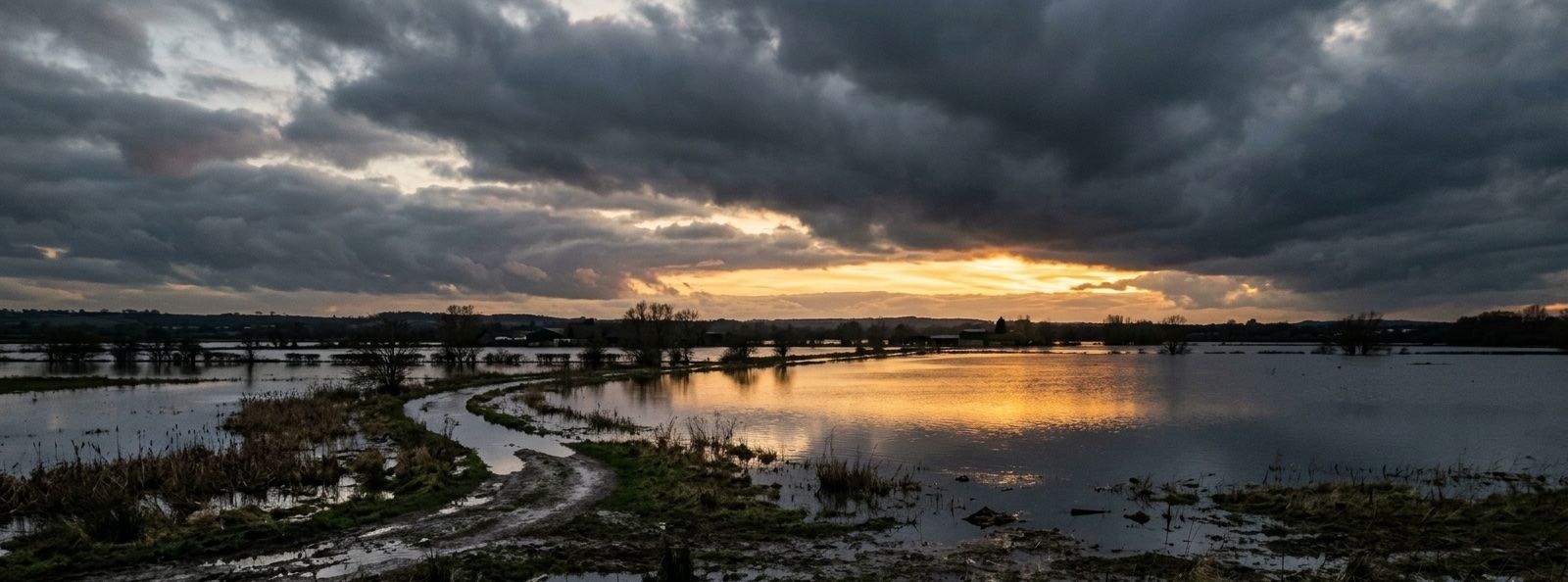
The book of Zephaniah opens with what sounds like the end of the world, and it means to.
"I will utterly sweep away everything from the face of the earth, declares the Lord. I will sweep away man and beast; I will sweep away the birds of the heavens and the fish of the sea" (Zephaniah 1:2-3). If those categories feel familiar, they should. Man, beast, birds of the sky, fish of the sea. That is the order of creation in Genesis 1, listed here in reverse, unraveling from the top down. Zephaniah is not reaching for dramatic language. He is reaching for a specific memory. The last time God swept the earth like this, it rained for forty days and the whole world went under.
He is invoking the flood. The Day of the Lord, he is saying, is that kind of event.
To understand why, you have to know what Zephaniah is writing into. He prophesies during the reign of Josiah, king of Judah, probably in the early years before the reform. The previous king, Manasseh, had ruled for fifty-five years. In that time, child sacrifice had been practiced in the valley outside Jerusalem. Idols had been set up inside the temple. The book of the Law had been lost and forgotten so completely that when a priest finally found it during Josiah's cleanup, the king tore his robes when he heard what was in it. An entire generation had grown up without ever hearing what God had actually asked of his people. The rot was not on the edges. It was structural.
Sound familiar?
In 2025, the percentage of Americans identifying as politically moderate reached a record low, and the Wall Street Journal described the American political system as having a total breakdown in trust between the two parties and among the general public. Eighty percent of American adults say Republicans and Democrats cannot agree on basic facts, not just policies. The division has stopped being political in any ordinary sense. It has become civilizational, a conflict over what kind of world is worth living in, conducted at a volume that makes actual conversation almost impossible.
While that argument plays out on screens and in comment sections, famine was confirmed simultaneously in parts of Gaza and Sudan in 2025, the first time two famines have been confirmed in the same year in the ten-year history of formal famine reporting. 318 million people were facing crisis-level hunger or worse heading into 2026. Children are starving in Yemen and South Sudan and Haiti while the people with the power and resources to respond are largely occupied fighting each other over things that will not matter to anyone in fifty years.
Zephaniah named his own version of this with the same specificity. Chapter 3 opens with a fresh indictment of Jerusalem: officials like roaring lions, judges like evening wolves that leave nothing till morning, prophets who are reckless and treacherous, priests who have profaned what is holy. Everyone with power was using it for themselves while the people below them absorbed the cost.
Chapter 2 moves outward through the surrounding nations. Philistia, Moab, Ammon, Cush, Assyria, each one charged. The mighty Assyrian empire, which had dominated the ancient Near East for a century, gets one devastating sentence: Nineveh will become a desolation, a dry wasteland where flocks lie down and owls roost in the windows. The most powerful nation in the world, reduced to a place where wild animals make their home. That is the arc of every empire that mistakes its own power for permanence.
Then chapter 3 does something that requires a moment to absorb. After all of it, after the de-creation imagery of chapter 1 and the catalogue of failures in chapter 3, Zephaniah 3:14 turns completely. Sing aloud, O daughter of Zion. Shout, O Israel. Rejoice and exult with all your heart. The same book that opened with God sweeping the earth bare closes with an instruction to sing.
Verse 17 lands heavy in the book: "The Lord your God is in your midst, a mighty one who will save; he will rejoice over you with gladness; he will quiet you by his love; he will exult over you with loud singing."
God is singing over his people.
This is the same God who in Genesis 6:6, before the flood waters rose, was grieved to his heart over what the world had become. Here, on the other side of everything, he is exulting with loud singing. The pattern is the same one Scripture keeps returning to. Corruption, de-creation, recreation. The flood comes and the world goes under and then the waters recede and God sets a rainbow in the sky. Jerusalem burns and the people go into exile and then Ezra reads the law in the square and the people weep and a wall goes up. The cross comes and the disciples scatter and then the tomb is empty. Zephaniah is not an obscure ancient curiosity. It is one of the clearest articulations of how God has always worked, which is that he does not preserve what is rotting. He sweeps it away and rebuilds from underneath.
That is not comfortable news when you are living in the rotting part.
The temptation for a Christian sitting with Zephaniah in 2026 is to pick a side in the political argument and idolize it, to decide that the de-creation happening around you belongs entirely to the other tribe and that your tribe is the remnant worth preserving. Zephaniah does not give you that option. He named the corruption inside Judah as thoroughly as he named it in the nations surrounding her. The people who assumed they were safe because they were the covenant people were not safe. The men Zephaniah singles out in 1:12 are not the obviously wicked. They are the complacent, the ones who have concluded that God is not paying close enough attention to matter.
The remnant described in chapter 3 is not defined by political affiliation or national identity. It is humble and lowly people who take refuge in the name of the Lord (Zephaniah 3:12). In a world offering a dozen identities to shelter inside, a party, a tribe, a nation, an ideology, Zephaniah says the only shelter that survives what is coming is the name of the God who grieved before the flood and sang on the other side of it.
The injustice is real. The division is not trivial. The children starving in Gaza and Sudan are not statistics. Zephaniah does not ask you to look away from any of it. He looked at his own moment with the same clarity and named what he saw without flinching.
He also knew what came after the sweeping.
The book ends with a God who is singing, not because the problems resolved or because the nations finally got it right, but because that is who God is on the other side of every de-creation event in the whole biblical story. The question Zephaniah leaves you with is not whether things are bad enough to warrant concern. They clearly are. The question is where you are standing while it happens, and whether you are sheltering in something that will still be there when the waters recede.
Loading comments…